















Why Maximising the Value of Existing Chemistry Is More Important Than Ever
Italian ryegrass has swiftly shifted from being a minor inconvenience to one of the leading grassweed threats in UK cereal cropping. Whereas blackgrass once dominated weed control concerns, ryegrass now presents increasingly complex and unpredictable resistance patterns. This growing resistance undermines the reliability of post-emergence herbicides and places ever greater strain on the few chemical options that remain effective.
Recent research conducted by WRAG and ADAS has confirmed the first cases of glyphosate-resistant Italian ryegrass within the UK. Additional populations have been identified as high risk following glasshouse screening. While glyphosate resistance is still geographically limited, its emergence underscores ryegrass’s remarkable adaptability, especially under the high selection pressure common in modern reduced-tillage cereal systems.
Beyond non-selective resistance, widespread resistance to ACCase and ALS herbicides is now firmly established. Teagasc resistance screening revealed that 81% of suspect ryegrass populations tested were confirmed resistant, with many exhibiting dual resistance to both ACCase and ALS chemistry. Crucially, resistance patterns vary from field to field, making assumptions about herbicide choice risky.
The message is clear: every percentage point of control now makes a meaningful difference.
Resistance Isn’t Always About Chemistry Failure – Often, It’s a Loss in Performance
While it’s tempting to blame poor ryegrass control solely on resistance, experts repeatedly emphasise that sub-optimal herbicide performance accelerates resistance selection. Weeds that survive such treatments contribute to the seedbank, perpetuating the problem.
In cereal crops, post-emergence ryegrass control is often compromised by several factors. The size of the weed at the time of herbicide application can reduce effectiveness, as larger ryegrass plants have leaves with thicker waxy cuticles. Additionally, when the crop canopy is tall, it intercepts more of the spray, and using drift-reducing nozzles in dry conditions can further reduce spray retention and coverage. These factors combine to result in weaker control, even when the chemistry itself could be effective.
Under such circumstances, even ryegrass plants that are theoretically susceptible may survive treatment. This effect can mimic resistance in the field, increasing long-term pressure on available chemistry and accelerating the development of genuine resistance.
It is in these scenarios that the choice of adjuvant becomes a matter of agronomic necessity rather than an optional extra.
Sorrento: Optimising Herbicide Delivery Amidst Resistance Challenges
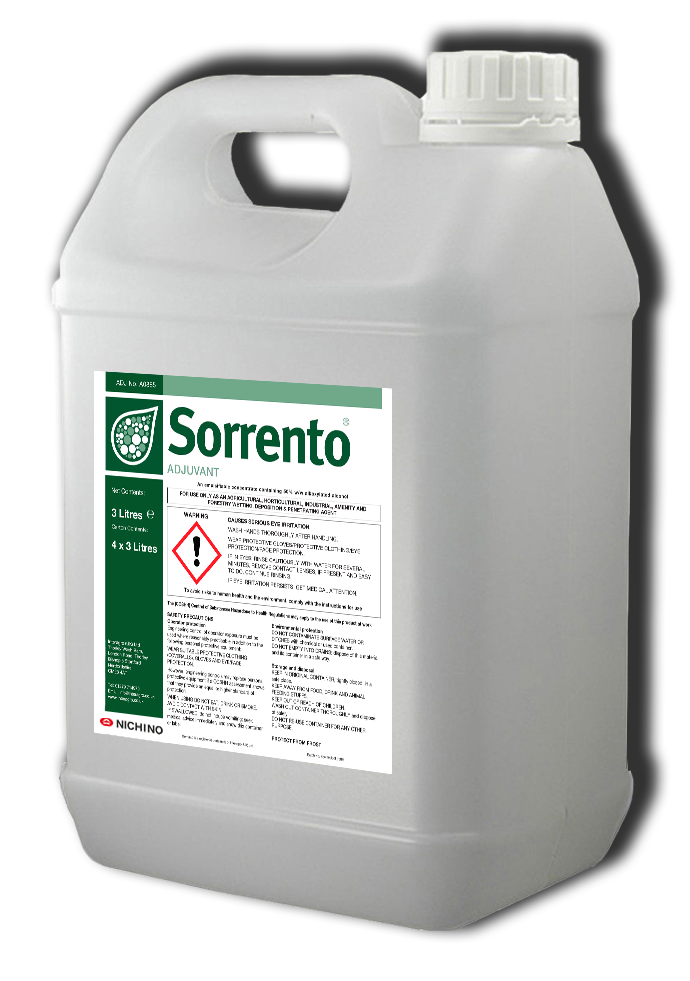
Sorrento is a low-dose activator adjuvant developed to address the main physical barriers that compromise post-emergence herbicide performance: coverage, retention, and penetration through the leaf cuticle.
Instead of altering the herbicide’s mode of action, Sorrento improves control by enhancing droplet spreading and adhesion on difficult grassweed leaves, facilitating the movement of moderately water-soluble actives into the leaf, and increasing both the speed and consistency of uptake, particularly under periods of weed stress.
This distinction is critical. Sorrento cannot overcome genetic resistance, but it can help ensure that susceptible and partially susceptible ryegrass plants receive an effective dose. This reduces the number of plants surviving through partial control and helps prevent the build-up of resistance that would otherwise need to be tackled in future seasons.
Trial Evidence: Transforming Marginal Control into Meaningful Progress
Repeated trials in the UK and across Europe have shown that supplementing post-emergence herbicides in cereals with Sorrento produces statistically significant improvements in grassweed control, particularly when spray performance is compromised by challenging conditions. Published data demonstrate that adding Sorrento to ALS-based herbicide programmes can boost efficacy by 42%. When combined with ACCase chemistry, such as pinoxaden-based products, improvements in performance can reach up to 73%, especially where coverage and uptake are limiting factors.
From a resistance management perspective, these gains matter. WRAG guidance stresses the necessity of near-complete control to prevent seed return, especially in non-inversion tillage systems where greater than 97% control may be required simply to keep ryegrass populations from expanding. Even modest improvements in control help reduce the number of survivors, lower the selection pressure for resistance, and protect the longevity of available herbicides.
Supporting Integrated Weed Management
Specialists in herbicide resistance are unanimous: chemical control alone is not enough to solve the ryegrass problem. Cultural strategies, including delayed drilling, rotational spring cropping, and targeted cultivation, remain vital components of an integrated weed management approach.
However, with fewer post-emergence chemical options remaining, it is essential to maximise the performance of the chemistry that is still available. Used correctly, Sorrento aligns closely with WRAG stewardship principles by helping to prevent survivors, ensuring label-rate herbicides achieve their full potential, and supporting robust programmes rather than encouraging dose reductions.
By improving reliability under challenging conditions, Sorrento enables agronomists and growers to make better use of resistance testing data, focusing on actives that remain effective instead of abandoning them prematurely.
Practical Take-Home Messages for Agronomists and Growers
Italian ryegrass resistance is a real and increasing concern, with highly variable patterns across different fields. Poor post-emergence performance not only leads to inadequate control but also accelerates the selection for resistance. In this context, adjuvants such as Sorrento are no longer optional, particularly where margins are tight. Sorrento helps deliver closer-to-potential control from existing chemistry, reducing both survivor numbers and seed return. Even small gains in efficacy today can make the difference between managing ryegrass effectively or rapidly losing ground to this adaptable weed.
In an era where every herbicide application must deliver, tools that safeguard performance will be central to the sustainability of UK cereal production.