















This year has brought one of the driest springs in living memory, but it is worth remembering that the season began very differently. Drilling conditions were supported by adequate moisture, followed by a prolonged wet spell that continued into early February. In parts of the South-West, rainfall totals came close to monthly records. It has been a striking reminder of how quickly a season can change.
Greater variability means greater uncertainty
As seasons become more changeable, with increasingly dramatic swings in temperature and rainfall, the one certainty is uncertainty. Decisions made at drilling, and the pre-emergence herbicide applications that follow, must set the crop up to cope with challenges that may not yet be clear. Crucially, those decisions must protect the crop without holding it back.
Understanding persistence and DT50
Pre-emergence herbicides vary widely in their persistence. This is commonly expressed as the DT50, the time taken for an active ingredient’s concentration in soil to decline by 50%. Familiar actives such as Diflufenican (DFF) are among the more persistent cereal herbicides, with reported DT50 values often exceeding 100 days and, under some conditions, approaching 300 days. Others persist for much shorter periods; Cinmethylin (Luxinum), for example, typically has a DT50 of around 15-40 days. Soil temperature, moisture, organic matter and, importantly, microbial activity all influence how long an active remains available in the soil. Higher microbial activity can accelerate degradation, reducing persistence as soil microorganisms break down the active ingredient.
| Active ingredient | Typical soil DT50 (days) |
| Flufenacet | 25-45 days |
| Pendimethalin | 30-90 days |
| Prosulfocarb | 6-50 days (typically 15-30) |
| Diflufenican (DFF) | 100-300+ days |
| Aclonifen | 35-90 days (can be >150) |
| Cinmethylin | 15-40 days |
| Triallate | 40-80 days |
| Picolinafen | 10-60 days |
| Clomazone | 15-40 days |
| Metazachlor | 10-25 days |
| Dimethenamid-P | 10-30 days |
| Ethofumesate | 30-60 days |
| Metribuzin | 10-30 days |
Why keeping the active in the right zone matters
BackRow Max helps hold the active in the upper soil zone for longer, concentrating the applied dose where it can have the greatest effect against emerging blackgrass and ryegrass. Just as importantly, it helps keep more of the herbicide away from emerging crop roots, reducing the risk that the crop is checked at establishment.
Bleaching, thinning and discolouration are all signs that a crop has been affected by herbicide stress. When this happens, energy that should be going into root and tiller formation is instead diverted into recovery and stress remediation. If we choose varieties partly for their vigour, it makes little sense to compromise that advantage with a leached herbicide not to mention their environmental fate.
Supporting Cinmethylin performance
Cinmethylin, is one of the strongest pre-emergence ryegrass and blackgrass actives currently available and a critical part of many programmes. Its emergency approval in Germany this autumn, despite not being registered there, underlines how important it is viewed within the grassweed control toolbox.
However, Cinmethylin’s persistence is more limited than some other residual actives, which is one reason it often forms part of a peri or post-emergence sequence following a more persistent pre-emergence option. If its effective persistence can be improved, the result is a more potent tool for blackgrass and ryegrass control.
Replicated trials conducted this year have shown a clear benefit from adding BackRow Max to Luximo mixes, with improvements seen in both wheat plant counts and blackgrass numbers.
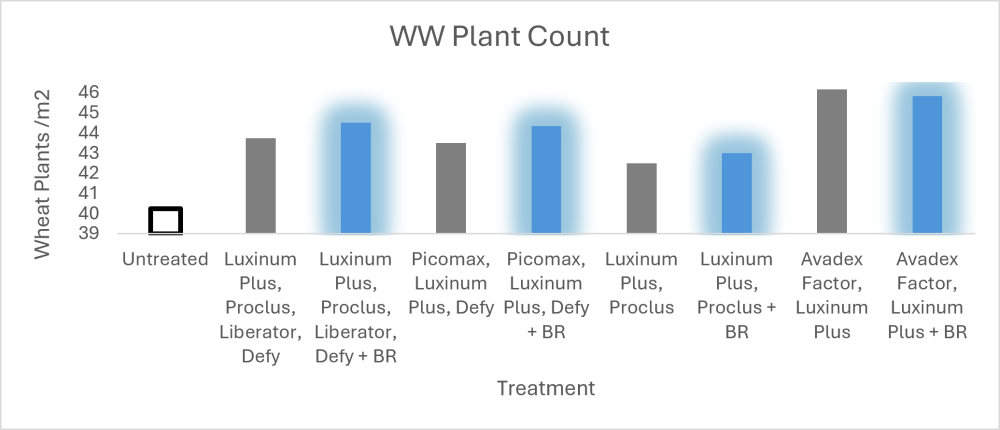
*Please note these mixtures are not supported by BASF
Improving spray coverage and extending the efficacy window
BackRow Max works by creating a more uniform spray pattern, reducing the number of very fine and very coarse droplets. This can improve control where application quality is compromised. At 100 L/ha, droplet deposition is unlikely to be fully uniform, which is where BackRow Max can have the greatest effect in improving spray distribution and overall weed control. When using air induction nozzles to reduce drift, we often see a compromise between the coarser droplets low drift nature but also their ability to disperse across the soil surface, BackRow Max helps remove the compromise giving you good effect across both parameters. It’s the combination of improved deposition, greater retention and low drift that makes BackRow Max a winning partner to key pre-emergence actives even in situations where their activity alone is considered to be good.
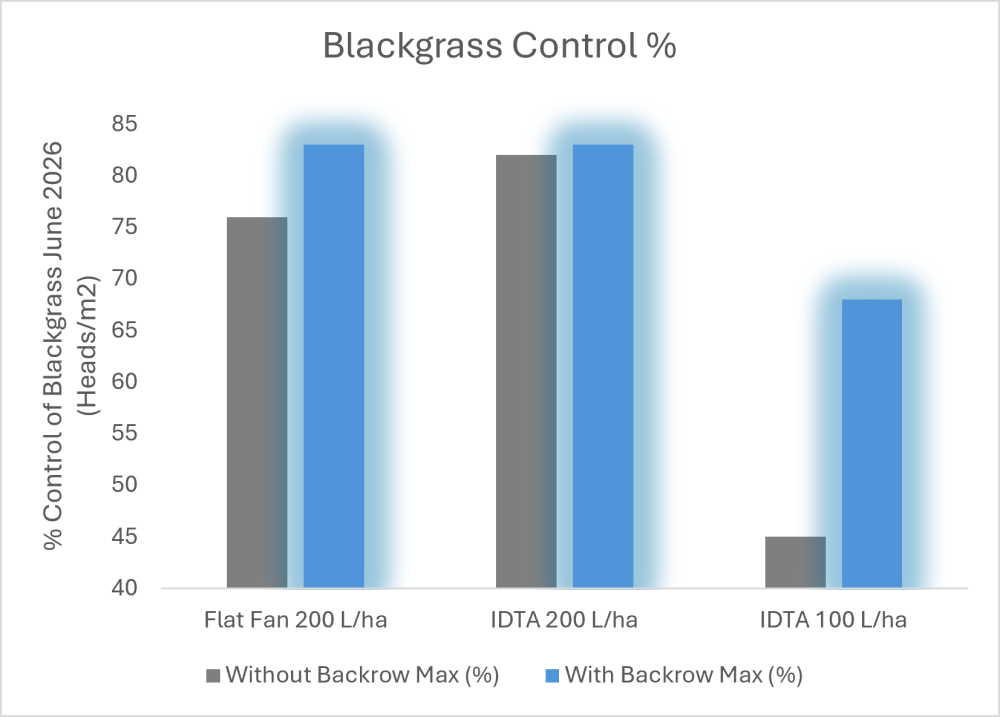
Where cinmethylin is limited by persistence for example, BackRow Max can help extend the effective activity window, supporting control of a greater proportion of emerging grassweed seedlings. Because it is based on mineral oil technology, rather than vegetable or methylated seed oils used in some other products, BackRow Max is designed to remain active for up to six weeks, aligning more closely with the residual herbicide molecules it is intended to support.