














In a potato market increasingly defined by quality, protecting skin finish and saleable yield has never mattered more. Moncut Max gives growers an early opportunity to help their crop make the cut.
For potato growers, the ultimate selection test begins after harvest. Every tuber is assessed against the requirements of its intended market, whether that means size, shape, skin finish, starch yield or freedom from visible defects.
Some make the cut. Others do not.
In autumn 2026, that distinction carries particular commercial weight. The British potato sector has emerged from a period of pronounced market volatility, high production costs and unpredictable weather. An April 2026 World Potato Markets briefing described 2025/26 as “a season of hard lessons”, with oversupply in the UK and, more particularly, continental Europe putting severe pressure on the free-buy market. The UK was at least partially shielded from prices that fell to zero in Belgium and the Netherlands because it is not self-sufficient in potatoes. Against this background, growers cannot afford to focus on tonnes lifted alone. What matters just as much is the proportion of the crop that meets the customer’s specification and earns its intended return. In an oversupplied market, buyers have more choice and may apply those specifications more strictly.
Quality earns its place
When markets are well supplied, buyers have choices. Inevitably, that can bring closer scrutiny of tuber quality.
In an outlook published ahead of the 2026 season, I highlighted reports of increased scrutiny from processors and buyers following European oversupply, together with a renewed emphasis on producing high-quality, blemish-free potatoes. The conclusion was clear: in a buyer-led market, skin finish and freedom from defects become increasingly important to market access and the fulfilment of contracts.
Levels of skin blemish that might have been accepted in a tighter market can assume much greater significance when buyers have ample supplies from which to choose. That leaves growers exposed to downgrading or rejection if a crop falls outside the required specification.
This is where Rhizoctonia, caused by Rhizoctonia solani, can have consequences extending far beyond crop establishment.
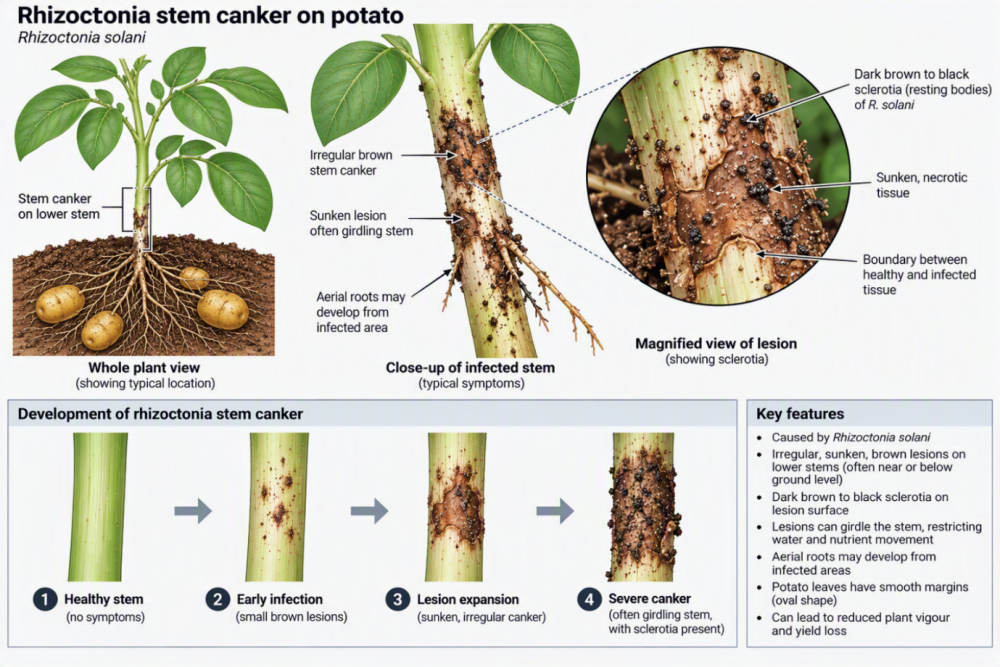
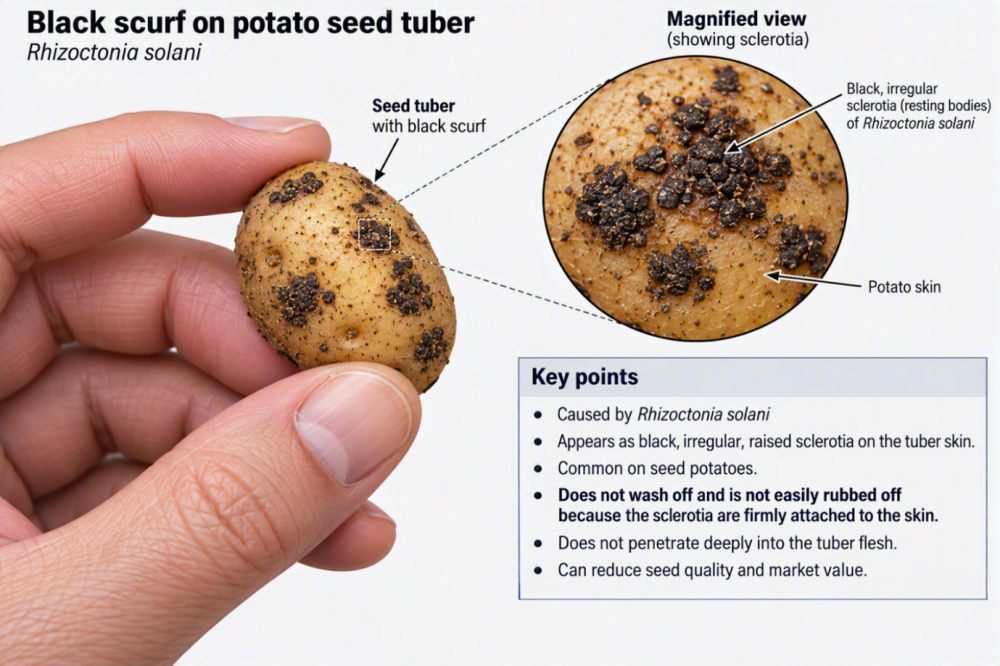
The pathogen is associated with stem and stolon canker, as well as black scurf on harvested tubers. Stem and stolon canker can contribute to delayed or uneven emergence and affect crop development. Black scurf leaves conspicuous dark sclerotia on the tuber surface, compromising appearance and potentially preventing otherwise sound potatoes from reaching premium grades.
Put simply, a crop may still produce plenty of tonnes, but if too many tubers fail the visual test, its marketable yield can tell a very different story.
Recent reporting has also identified knowledge gaps around Rhizoctonia under changing production systems. The last significant UK survey of the anastomosis groups affecting potato crops was conducted in 2001–03. It found that 92% of isolates from infected tubers were AG3PT and 7% were AG2-1. More recent research has detected both AG3 and AG2-1, but there has not yet been a comparable national survey against the background of today’s regenerative and reduced-tillage practices.
Reduced tillage may encourage the survival of R. solani mycelium and sclerotia, while the effects of more diverse rotations and cover crops are complex. AG2-1 can infect brassicas and colonise wheat, for example, while infected debris may allow AG3 to persist through a rotation. Infected seed also remains an important source of inoculum. Until those knowledge gaps are filled, good husbandry and appropriately selected seed- and soil-applied fungicides remain important control measures where risk is identified.
Protection cannot be added retrospectively
Rhizoctonia management requires decisions to be made early. Once the crop is established and symptoms begin to appear, the principal opportunity to protect seed tubers and developing shoots has passed.
Risk is influenced by several factors. Cool conditions can slow crop development, increasing the period in which young stems and stolons are vulnerable. Published agronomic guidance indicates that the pathogen can cause most damage in cool, dry to slightly moist soil conditions, while infected seed is another important source of inoculum. There is also evidence of an interaction with potato cyst nematode. PCN feeding has been associated with increased stolon infection, while PCN-weakened plants may be more vulnerable to secondary infection by opportunistic pathogens such as R. solani. Where PCN and Rhizoctonia risks coincide, that interaction should be considered as part of the field’s overall disease-risk assessment and discussed with the grower’s agronomist.
Seed assessment is therefore an essential starting point. Growers and agronomists should examine the health and disease loading of incoming seed and consider the field’s soil-borne disease risk, cropping history, intended market and varietal requirements.
Where Rhizoctonia risk is identified, Moncut Max provides a liquid potato seed-treatment option containing the SDHI fungicide flutolanil. The suspension-concentrate formulation contains 460 g/l flutolanil and is intended for application as a liquid seed treatment.
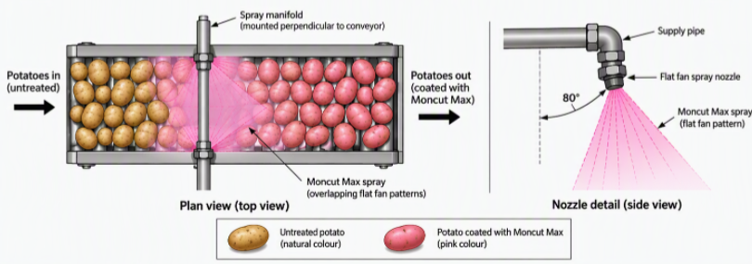
Applied before planting using suitable specialist equipment, the treatment protects the tuber externally. Because flutolanil has only minimal uptake within the tuber and plant, complete and uniform coverage is fundamental. Untreated areas can remain exposed even when the correct overall quantity of product has been applied per tonne. This makes application quality just as important as product choice.
Moncut Max can be applied several weeks before planting using a specialist liquid applicator mounted above a roller table or conveyor. Current Nichino UK guidance recommends staggered 80-degree hollow-cone nozzles for the best results, although suitably angled flat-fan nozzles may also be used. Treatment must be undertaken in accordance with the product label, using correctly calibrated equipment and appropriately qualified operators.
Making every seed tuber count
Seed treatment should not be viewed in isolation. It forms part of an integrated approach that includes seed inspection, field-risk assessment, suitable planting conditions, good soil structure and timely establishment. Where soil-borne risk has been identified, an authorised in-furrow fungicide treatment may also form part of the programme, subject to the product label and agronomic advice.
Nevertheless, seed treatment occupies a particularly important place in the programme because it is a one-time opportunity. This is highly relevant when crop margins are tight. Cutting an early input may create an immediate saving, but any resulting loss of skin quality may only become apparent after expenditure on planting, nutrition, irrigation, blight protection, haulm destruction, lifting and storage has already been incurred. The more useful question is therefore not simply, “What does the seed treatment cost?” It is, “What value is placed at risk if the crop fails to reach its intended grade?”
Ready for the final selection
No single intervention can guarantee the yield, size profile or final specification of a potato crop. Weather, soil conditions, variety, nutrition, irrigation, harvest timing and storage all play important roles. But growers can act on the risks identified before planting. By assessing seed carefully, understanding field history and applying Moncut Max correctly where Rhizoctonia risk warrants treatment, growers can protect quality from the beginning rather than trying to account for lost value at the end.
In a market where appearance can determine whether a tonne earns its intended return, the first step towards marketability is giving every tuber the best possible start.