















The loss of diquat from potato desiccation programmes has reshaped how growers approach the end of crop management. What was once a relatively simple “burn-down” exercise has evolved into a more considered and integrated process, where chemistry, timing and technique all play a defining role. In this new landscape, protoporphyrinogen oxidase (PPO) inhibitors have become central to desiccation strategies, with Nichino’s Pyraflufen-ethyl, marketed as Gozai, now firmly established as a key tool in this process.
Maximising performance of PPO inhibitors like Gozai starts with a good understanding of how this chemistry works. Knowing its behaviour in relation to the environmental conditions, in particular ultraviolet wavelengths of sunlight, and how the active should be applied in a wider system, will significantly increase the efficacy and lead to the most cost-effective result.
At its core, the purpose of haulm destruction remains unchanged. Effective desiccation is essential to halt tuber bulking at the target size, promote robust skin set, and encourage stolon detachment ahead of harvest. Failure to remove canopy quickly and completely can delay the lifting window, increase the risk of damage at harvest, and push tubers beyond desirable market specifications. As a result, desiccation continues to be one of the most important management steps in the potato production cycle.
Where things differ today is in how that outcome is achieved. The absence of diquat has pushed growers towards more staged programmes, often combining mechanical and chemical approaches. Rather than relying on a single pass, desiccation is increasingly a sequence of actions designed to open the canopy, expose the stems, and complete the kill in a controlled manner.
The behaviour of Gozai underpins much of this shift. Containing 26.5 g/L of pyraflufen-ethyl, it belongs to the Group 14 PPO inhibitors, a class of chemistry that behaves very differently from systemic actives. Its activity is entirely contact-based, with negligible movement within the plant itself. This means that only those tissues directly contacted by the spray will be desiccated, placing far greater emphasis on application technique than was historically required.
At the biochemical level, PPO inhibitors act by disrupting chlorophyll synthesis through inhibition of the enzyme protoporphyrinogen oxidase. This leads to the accumulation of photodynamic compounds which, in the presence of light, generate reactive oxygen species. These free radicals go on to rapidly degrade cell membranes, causing structural breakdown and desiccation of plant tissue. In the field, this can often be observed within hours of application, as leaves take on a wet, scorched appearance, a visual indication that the outer cell layers are collapsing. The key here is that PPO inhibitors are “photodynamic compounds” meaning they need UV light to create the free radicals which cause the leaf tissue degradation.
This mode of action explains two important characteristics that define Gozai performance. Firstly, activity is rapid where contact is achieved, leading to visible necrosis of treated foliage. Secondly, efficacy is heavily influenced UV light with bright conditions accelerating the destructive process. In practical terms, this means that application timing and environmental conditions are just as critical as the dose rate.
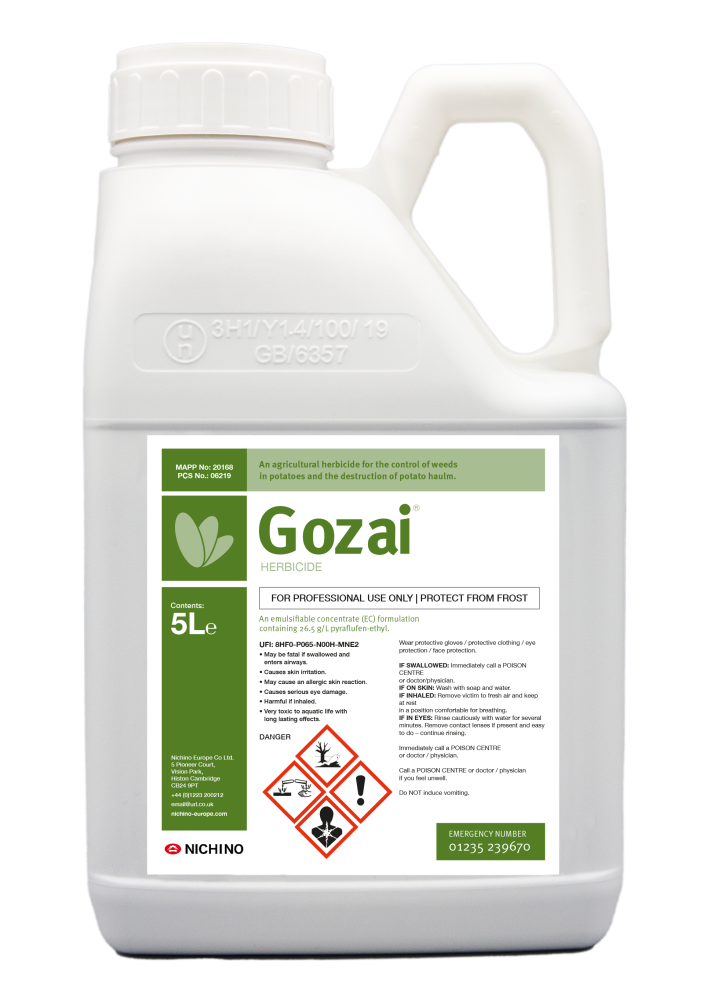
In terms of performance, Gozai is capable of delivering effective foliage and stem desiccation, but only where coverage is good. Unlike a systemic herbicide, of which are there are non-suitable for desiccation of potatoes, it will not compensate for poor spray deposition, leaving untreated tissue green and capable of regrowth and blight infection. While canopy collapse may appear slightly slower than with legacy diquat-based programmes, well-executed applications can deliver comparable results within a matter of days under favourable conditions.
Stem destruction, however, remains the most challenging aspect of any chemical desiccation strategy. In dense or actively growing crops, leaf material can shield stems from spray penetration, limiting product contact. For this reason, a multi-stage approach is often required, either using initial applications to open up the canopy and/or integrating a flailing pass to expose stems ahead of follow-up treatments.
Application strategy is therefore fundamental. Timing should align with the onset of natural senescence, when canopy vigour is beginning to decline but plants remain physiologically active enough to support uptake. Spraying too early into a lush, actively growing crop can reduce efficacy and extend the overall programme duration.
Coverage is arguably the most critical factor of all. Given the lack of translocation, achieving complete wetting of the target is essential. This is why higher water volumes, typically around 300 L/ha, are recommended, alongside the use of Toil to improve spray retention and penetration. Any compromise in coverage will inevitably lead to patchy results and increased risk of regrowth and blight infection.
Environmental conditions play a similarly important role. Gozai performs best in bright, sunny conditions where high light intensity drives faster cellular destruction. Adequate soil moisture supports plant metabolism and improves uptake, while warm temperatures enhance reaction rates. As such, applications made early in the day under favourable weather typically deliver the most consistent results.
A new strategy is the integration of Gozai ahead of a flail-and-spray program and has become increasingly common outside of the UK. Applied 2-3 days ahead of flailing, it can begin to weaken the canopy and initiate senescence. Alternatively, post-flail applications benefit from improved access to stems, allowing for more targeted and effective destruction. Maintaining sufficient stem height after flailing is important to ensure there is adequate target material for follow-up sprays, typically 15-20cm.
From a programme perspective, Gozai should be positioned early within the desiccation sequence wing to its 14 day harvest interval. Application at 0.8 L/ha, with up to two treatments spaced at least seven days apart, provides the foundation for canopy removal, with the 14-day harvest interval requiring careful planning within the overall sequence. Sequential applications with other PPO inhibitors such as Carfentrazone are typically required to fully complete stem kill, particularly in vigorous crops or challenging conditions.
An additional consideration is the ongoing risk of late blight during desiccation. As long as green tissue remains within the canopy, infection risk persists, making it essential to maintain fungicide protection throughout the programme. Tank-mixing with products such as cyazofamid is a common approach to managing this risk.
Ultimately, the move away from diquat has reinforced the importance of agronomy in desiccation decisions. PPO-based chemistry, including Gozai, offers a viable and effective solution, when used as part of a well-planned, system-based approach. Timing, technique, environmental awareness and integration with mechanical methods all contribute to the outcome.
For today’s growers and agronomists, the challenge is no longer simply choosing a product, but understanding how to use it. When applied in line with best practice and supported by a robust programme, Gozai can deliver consistent haulm destruction, reliable skin set, and improved harvest efficiency.
Some typical desiccation strategies could include:
Straight Gozai
T1 (Start of Senescence): Gozai @ 0.8L/Ha + Toil
T2 (Follow-Up 7 days later): Gozai @ 0.8L/Ha + Toil
Be mindful of total dose restriction of Gozai if used for weed control earlier in the season.
Flail + Gozai + Gozai
Flail (Start of senescence)
T1 (Follow Up 2-3 days later): Gozai @ 0.8L/Ha + Toil
T2 (Follow-Up 7-10 days later if required): Gozai @ 0.8L/Ha + Toil
Be mindful of total dose restriction of Gozai if used for weed control earlier in the season.
Gozai + Flail + Gozai
T1 (Pre-Flail Application): Gozai @ 0.8L/Ha + Toil
Flail (2-3 days later)
T2 (Post Flail Application): Gozai @ 0.8L/Ha + Toil
Robust program for indeterminate varieties or challenging conditions. Be mindful of total of dose restrictions if a weed control application has already been made.
Gozai is a contact herbicide and contains pyraflufen-ethyl. Gozai is a registered trademark. Use plant protection products safely. Always read the label and product information before use. Pay attention to the risk indications and follow the safety precautions on the label. For further information, including contact details visit www.nichino.uk or call 01223 855720