















Recent dry springs like the one we’re having now have become an increasingly familiar challenge for potato growers and agronomists, placing early season weed control under pressure. Its true that residual herbicides remain the backbone of potato programmes, but their performance is fundamentally dependent on soil moisture. Where moisture is lacking like this spring, weed emergence becomes more staggered and less predictable, and the residuals become less reliable for effective control, allowing escapees to survive and go on to compromise yield before the crop has the chance to compete.
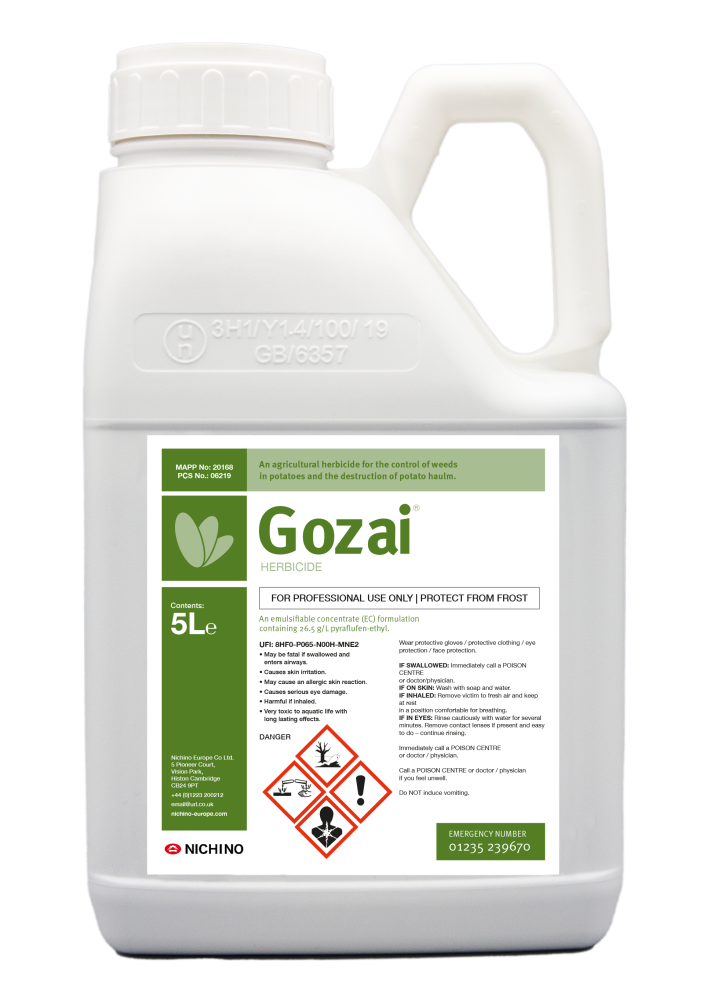
In these situations, the value of complementary modes of action become clear. Pyraflufen ethyl, formulated as Gozai, offers a targeted way of supporting residual programmes when conditions are dry and their effectiveness may be compromised.
Why dry conditions expose weakness in residual programmes
Residual herbicides rely on being taken up by germinating weeds via soil moisture. In dry seedbeds or cloddy ridges, several issues commonly arise:
• Reduced activation of soil applied residuals
• Uneven herbicide distribution across ridges
• Delayed or staggered weed emergence
• Survival of weeds emerging and subsequently competing with the crop
Potatoes are especially vulnerable before canopy closure. Slow early growth leaves the crop exposed, and even modest weed populations can reduce yield through early competition for moisture, nutrients and light. Once weeds emerge, the options available to tidy up escapes are limited, particularly where crop has already emerged. This is where a fast acting, contact herbicide can add real value.
Understanding where pyraflufen ethyl fits
Pyraflufen ethyl is a PPO (protoporphyrinogen oxidase) inhibitor with pure contact activity on green tissue. It causes rapid cell membrane disruption in susceptible broad leaved weeds, with visible symptoms appearing rapidly post application.
Crucially, pyraflufen ethyl does not rely on soil moisture for activity. Its strength lies in controlling weeds that have already emerged through residual layers, a scenario that becomes more common in dry springs.
Used at low rates and applied to small weeds, Gozai provides a reliable way of removing early competition while protecting the integrity of the wider residual programme. Supporting residuals rather than chasing failures
One of the most important shifts in potato weed control thinking is moving away from the idea of “rescue sprays”. Contact herbicides perform best when used proactively, not reactively. In dry conditions, adding Gozai to an existing residual mix allows growers and agronomists to:
• Remove emerged weeds before they become competitive
• Maintain a clean ridge while residuals continue to provide background control
• Reduce pressure on a narrow group of soil acting herbicides
• Improve programme resilience where emergence patterns are uneven
Because pyraflufen ethyl acts only on contacted foliage, crop selectivity is excellent when applied according to label guidance. This makes it well suited to early season use where crop emergence risk must be carefully managed.
Performance where residuals struggle
Field experience and UK guidance consistently show that residuals perform best when applied to fine, moist seedbeds and followed by rainfall. In contrast, many recent seasons have delivered extended dry spells after planting, limiting activation.
In these scenarios, weeds such as groundsel, volunteer oilseed rape, fat hen and black bindweed are more likely to emerge through residual layers. These species are well suited to contact control when small, and pyraflufen ethyl is particularly effective at this early growth stage.
By removing these early escapes promptly, Gozai helps prevent yield loss and reduces the need for more aggressive follow up interventions later in the season.
Integrating Gozai into modern programmes
Rather than being viewed as an “either/or” choice, Gozai should be considered a strategic partner to residual herbicides. Its role is to tidy what residuals miss, especially when conditions compromise soil activity.
This integrated approach helps future proof weed control by spreading pressure across different modes of action, while providing agronomists with flexibility in increasingly unpredictable seasons. Importantly, this strategy is as much about risk management as outright efficacy. By stabilising performance under dry conditions, programmes become less reliant on rainfall timing and are more robust overall.
A practical tool for an unpredictable climate
As spring weather patterns continue to challenge traditional potato weed control strategies, products that add reliability and flexibility are becoming more valuable. Pyraflufen ethyl is not new chemistry, but its role in modern programmes is becoming clearer. Used correctly, Gozai offers a targeted solution for managing emerged broad leaved weeds and reinforcing residual stacks when dry soils threaten performance. In doing so, it helps maintain a weed free start, still one of the most critical foundations of successful potato production.
Gozai is a contact herbicide and contains pyraflufen-ethyl. Gozai is a registered trademark. Use plant protection products safely. Always read the label and product information before use. Pay attention to the risk indications and follow the safety precautions on the label. For further information, including contact details visit www.nichino.uk or call 01223 855720