















As soils warm up in spring, increased moisture and microbial activity lead to rapid biomass development and swift germination. It is therefore unsurprising that spring-sown crops emerge quickly and progress through their growth stages more rapidly than their winter-planted counterparts. However, the same favourable conditions that accelerate crop growth also encourage weed development, making weed control in spring cereals particularly demanding. Post-emergence herbicide options are often limited by a cut-off point at the flag leaf stage, which can arrive sooner than anticipated, especially during a mild spring. If weeds persist after pre-emergence treatments, remedial applications in May can introduce additional stress and risk to the crop, especially when a more effective alternative is available.
The Role of BackRow Max in Spring Crops
BackRow Max is Nichino’s flagship pre-emergence herbicide companion product, designed to extend the period that herbicides remain active within the soil. It is proven to retain the herbicide in the upper soil layers where weed seeds are most likely to germinate, but above the rooting zone of the crop. This dual action not only protects the crop by acting as a safener but also improves weed control. One of the notable risks associated with spring applications of pre-emergence herbicides is the larger root mass of spring crops. While this is beneficial for nutrient and moisture uptake, it also raises the risk of herbicide damage if the chemical reaches the rooting zone. Consequently, spring crops are generally more susceptible to herbicide damage than winter crops, making a partner like BackRow Max essential for maintaining crop vigour and preventing thinning of the stand.
Unique Qualities of BackRow Max
BackRow Max distinguishes itself from other pre-emergence partners by being based on mineral oil rather than vegetable or seed oils. This composition makes it more resistant to microbial breakdown, allowing it to remain active for an extended period. In spring, increased soil temperatures promote microbial activity, which is beneficial for nutrient cycling but can accelerate the degradation of herbicides and adjuvants. Typically, the effective period of a herbicide in spring crops is shorter than in autumn-sown crops, so incorporating BackRow Max helps to maintain herbicide activity longer, ensuring better control over later-emerging weeds before the crop canopy closes.
Broader Applications Beyond Herbicides
The benefits of BackRow Max are not limited to herbicides. The same principles apply to soil-applied fungicides such as Azoxystrobin (Amistar), used for Rhizoctonia control in potatoes. For growers aiming to safeguard both yield and quality, a comprehensive approach involves using Moncut seed treatment prior to planting, followed by a ridge application of Azoxystrobin, where BackRow Max enhances the fungicide’s effectiveness. By including BackRow Max, Azoxystrobin remains active in the soil profile for a longer duration, extending protection against pathogens like Rhizoctonia solani, the cause of Black Scurf.
How BackRow Max Works
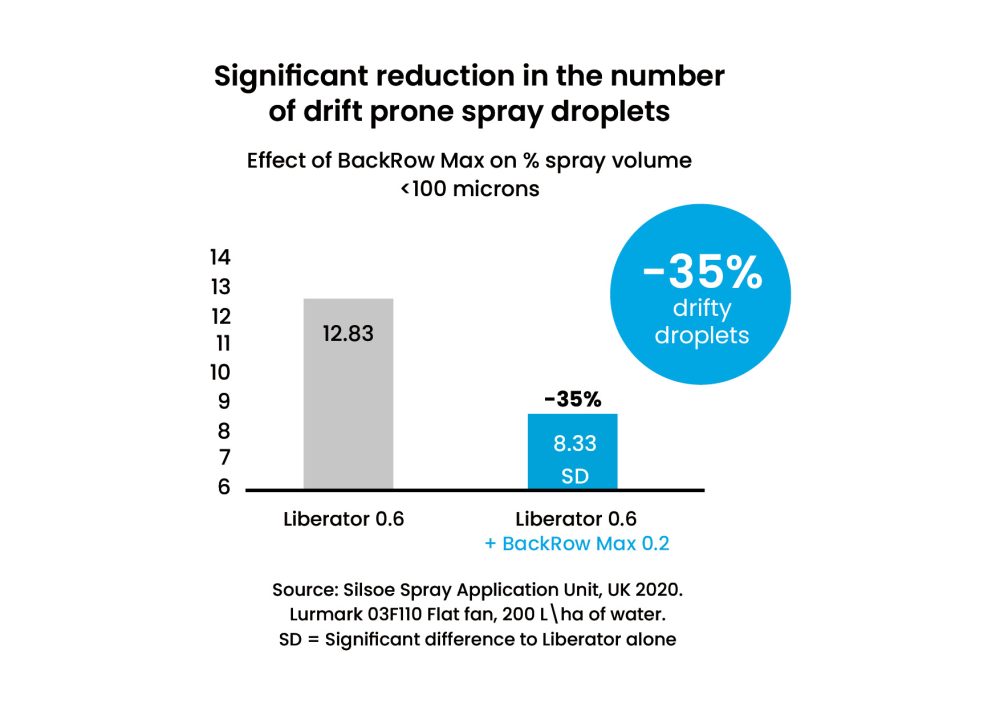
BackRow Max operates via two distinct pathways. The first is between the sprayer nozzle and the soil surface, where it optimises spray coverage and deposition. It achieves this by reducing the formation of both very fine and very coarse droplets, resulting in a more uniform spray pattern. Trials conducted at Silsoe have shown that BackRow Max reduces the number of fine, drift-prone particles by 35%, leading to more consistent deposition on the soil surface, a critical factor for successful pre-emergence applications.
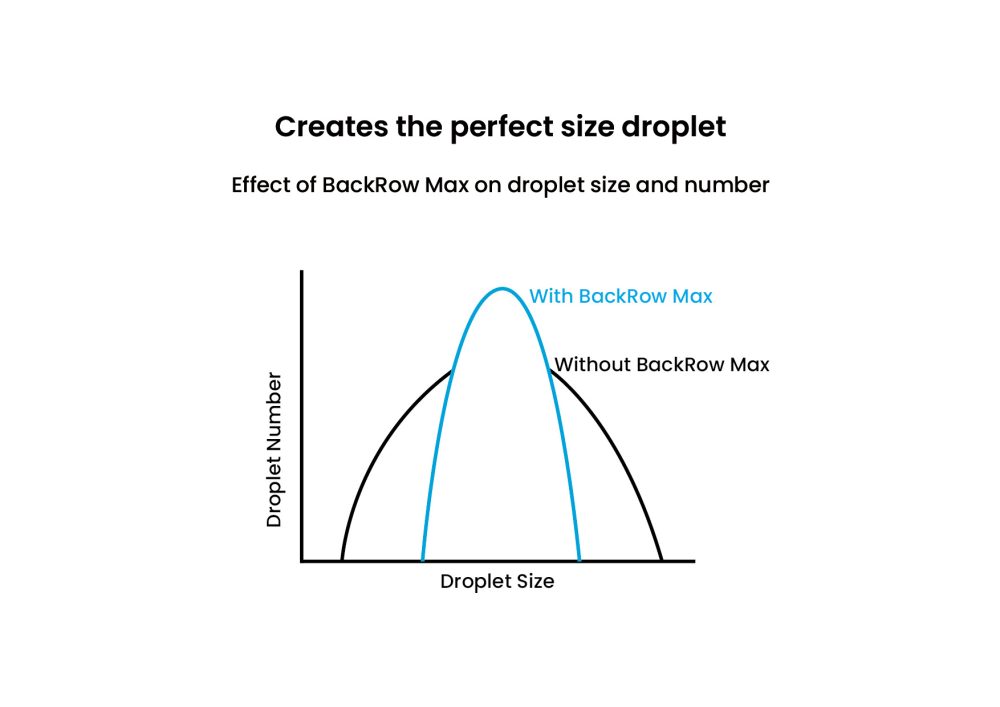
Once on the soil, BackRow Max’s efficacy is driven by its ability to form micelles within the spray solution. These micelles are created by specially developed molecules with hydrophilic (water-attracting) heads and hydrophobic (water-repelling) tails. The hydrophobic tails bind to the herbicide molecule, enveloping it in a hydrated shell. This produces a humectant effect, reducing the dependency on rainfall for herbicide activation. In dry conditions, BackRow Max sustains herbicide activity even when moisture is limited. Additionally, these micelle structures help bind the herbicide to soil cavities, preventing leaching towards the crop roots and beyond, thus acting both as a safener and a sustainer of herbicide efficacy.
Application Recommendations
Regardless of the drilling conditions this spring and with an approval for application in a wide range of crops, BackRow Max applied at a rate of 0.4 L per hectare enhances the performance of your pre-emergence herbicide programme.
BackRow Max is available exclusively from Agrii.